Healthamu may earn a commission if you buy through links on this page, at no extra cost to you. That does not change what we report.
Part of our Theyavue overview. Last checked October 20, 2026.
Does Theyavue work? Nobody can say yet, because no clinical trial of the Theyavue capsule has been published. What exists is research on some of its 24 ingredients. The strongest of it, the Age-Related Eye Disease Study (AREDS), tested high doses of vitamins C and E, beta-carotene and zinc in people with macular degeneration[3]. Theyavue uses smaller amounts of those nutrients, and it hides lutein and zeaxanthin inside a 240.5 mg proprietary blend with no individual amounts[2].
Does Theyavue work? The short answer
The evidence does not show that Theyavue works, and it does not show that it fails. It was never tested. The vendor says each ingredient is "scientifically proven to maintain healthy eyes and vision"[1], but ingredient studies cannot stand in for a test of the finished product.
Here is what can be said from the label and the research. Vitamin C, vitamin E, zinc, copper, lutein and zeaxanthin have Moderate evidence, and only for people who already have intermediate or advanced age-related macular degeneration (AMD)[3][4]. Theyavue gives 40% of the AREDS vitamin C dose, about 11% of the vitamin E dose and 40% of the zinc dose at 2 capsules a day.
What cannot be concluded: whether it sharpens eyesight, helps night driving or makes fine print easier to read. No study of the product measured any of that.
Which evidence levels should you not confuse?
Supplement marketing often blends four different kinds of evidence into one claim. Only the last two would tell you whether Theyavue works.
Plausibility
Lutein and zeaxanthin are carotenoids found in the macula, the center of the retina. That is a reason to study them. It does not show that swallowing them changes your vision.
Ingredient trials
AREDS and AREDS2 are large randomized trials of specific nutrients at specific doses[3][4]. Their results apply to those doses and to people with AMD. A smaller product that shares some names does not inherit them.
Finished-product trial
A trial that gives Theyavue capsules to one group and a placebo to another, then measures vision, would answer the question directly. We found none, checked October 20, 2026.
Replication
One trial is a start. Confidence rises when a second, independent team repeats the result. With no first trial, Theyavue has nothing to repeat.
Theyavue claims vs what the evidence supports
The sales page makes several eye claims and pins some of them to single ingredients[1]. Set against the studies, most of them stretch further than the data goes.
| Vendor claim | Reasonable reading | Limitation |
|---|---|---|
| Each ingredient is "scientifically proven" | Some ingredients have eye research; many do not | Biotin, B12, magnesium and chromium have no eye trial at all |
| Lutein "helps filter light and protects your eyes from sun damage" | Lutein with zeaxanthin did well in AREDS2 against beta-carotene[5] | AREDS2 used 10 mg lutein; Theyavue does not disclose its amount |
| Rutin "may support blood flow to your retina" | A drug derived from rutin, troxerutin, was tested in retinal vein occlusion[8] | Troxerutin is a different compound; no oral rutin eye trial was found |
| Calcium "has been shown to maintain healthy eyesight" | Observational studies point in opposite directions[9][10] | No randomized trial; Theyavue has 25 mg a capsule, 2% of the daily value |
| Antioxidants "can optimize vision, including night vision" | Bilberry is the classic night-vision ingredient | Rigorous bilberry trials for night vision were negative[7] |
Which ingredients matter most?
The six AREDS and AREDS2 nutrients matter most, because they are the only ones with Moderate evidence for eyes. Each one in Theyavue runs into a dose, form or population mismatch with the studies.
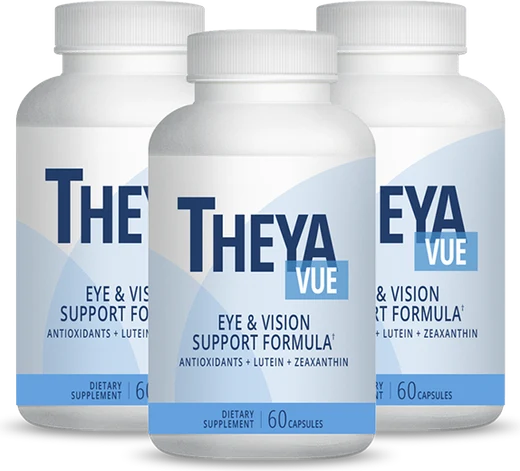
- Lutein and zeaxanthin: AREDS2 used 10 mg and 2 mg a day[4]. In Theyavue both share a 240.5 mg blend with eight other ingredients, so the dose is unknown.
- Zinc: 32 mg a day at 2 capsules versus 80 mg in AREDS. AREDS2 found a lower zinc dose worked about as well[4], so this gap may matter less than the others.
- Vitamin C and E: 200 mg and 20 mg a day, against 500 mg and about 180 mg in AREDS[3].
- Population: the benefit appeared in people with intermediate or advanced AMD. People with healthy eyes or blurry reading vision were not the group studied.
The full breakdown is on our Theyavue ingredients page.
What results are realistic to expect?
Expect nothing that a study has not measured. AREDS and AREDS2 were multi-year trials that counted how many people progressed to advanced AMD[3][4]. Neither trial measured sharper sight within weeks, and neither tested people with healthy eyes who want clearer reading vision.
The Veterans LAST trial reported a gain in visual acuity with lutein in people with atrophic AMD[6]. That is one trial, at a known lutein dose, in a specific group, and Theyavue's lutein dose is not printed.
So a realistic reading is that any benefit, if it exists at these doses, would be slow and hard to notice. The vendor's 60-day refund window, checked October 20, 2026, is far shorter than any of these trials.
When should you see a doctor instead?
A supplement is the wrong first step when vision changes. See a doctor or go to an emergency room right away if you notice:
- sudden loss of vision in one or both eyes, even if it comes back
- a shower of new floaters, flashes of light, or a curtain over part of your view
- straight lines that look wavy or bent, or a new dark spot in the center of vision
- eye pain with redness, halos around lights, headache or nausea
- double vision or vision loss with weakness, numbness or trouble speaking
Struggling with fine print or night driving also deserves an eye exam, since glasses, cataract checks and AMD screening come first. Our Theyavue side effects page covers safety.
Evidence conclusion
Theyavue has not been shown to work, and the parts with the most research are either underdosed or undisclosed.
| Decision question | Current assessment |
|---|---|
| Has Theyavue been tested in people? | No published trial found, checked October 20, 2026 |
| Are the strongest ingredients at study doses? | No: C, E and zinc are lower; lutein and zeaxanthin are not disclosed |
| Who did the ingredient research cover? | Mainly adults with intermediate or advanced AMD |
| Is there a refund if it does nothing for you? | 60 days, with conditions on our Theyavue legitimacy page |
If you still want to try it, the vendor's page and current prices are below. We explain how we check products on our methods page.
Back to the Theyavue overview.
Frequently asked questions
Does Theyavue really work for eyesight?
No study has tested Theyavue capsules, so there is no evidence that it improves eyesight. Some ingredients were studied in people with macular degeneration, but at higher or known doses that the Theyavue label does not match.
How long does Theyavue take to work?
No timeframe exists because the product was never tested. The related AREDS trials ran for years and measured disease progression, a far longer span than the vendor's 60-day refund window, checked October 20, 2026.
Can Theyavue replace glasses or eye drops?
No. Nothing in the label or the research suggests a supplement can replace glasses, prescribed drops or eye care. Blurry reading vision and night driving trouble call for an eye exam first.
Is Theyavue the same as an AREDS2 formula?
No. AREDS used 500 mg vitamin C, 400 IU vitamin E and 80 mg zinc with copper, and AREDS2 tested 10 mg lutein with 2 mg zeaxanthin. Theyavue has less C, E and zinc and hides its lutein and zeaxanthin amounts.
Who might consider Theyavue at all?
Anyone considering it should ask an eye doctor first, especially people with macular degeneration, who may be better served by a formula that matches AREDS2 doses. The doctor can also check medicines and planned blood tests.
Sources
- TheyaVue product page. Theyavue vendor, read October 20, 2026.
- TheyaVue Supplement Facts panel. Theyavue vendor, read October 20, 2026.
- A randomized, placebo-controlled trial of high-dose supplementation with vitamins C and E, beta carotene, and zinc for age-related macular degeneration: AREDS report no. 8. Archives of Ophthalmology, 2001, read October 20, 2026.
- Lutein + zeaxanthin and omega-3 fatty acids for age-related macular degeneration: the AREDS2 randomized clinical trial. JAMA, 2013, read October 20, 2026.
- Secondary analyses of the effects of lutein/zeaxanthin on AMD progression: AREDS2 report no. 3. JAMA Ophthalmology, 2014, read October 20, 2026.
- Double-masked, placebo-controlled, randomized trial of lutein and antioxidant supplementation in atrophic AMD: the Veterans LAST study. Optometry, 2004, read October 20, 2026.
- The effect of Vaccinium myrtillus (bilberry) on night vision: a systematic review of placebo-controlled trials. Survey of Ophthalmology, 2004, read October 20, 2026.
- Troxerutin in retinal vein occlusion: a randomized trial. PubMed record, read October 20, 2026.
- Dietary and supplemental calcium and progression of AMD: AREDS report no. 39. PubMed record, read October 20, 2026.
- Association between calcium supplementation and AMD in NHANES. PubMed record, read October 20, 2026.
This page is general information, not medical advice. Dietary supplements are not reviewed by the FDA for safety or effectiveness before they are sold and are not intended to diagnose, treat, cure or prevent any disease. Talk to your doctor before taking any supplement, especially if you are pregnant, nursing, take medication or have a health condition.